


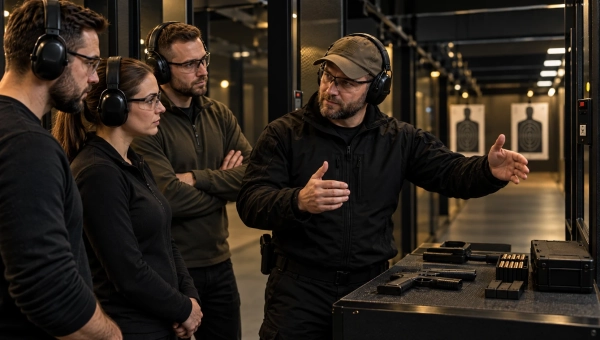
Safety at a shooting range is not an addition to technique. It is the foundation of every training session. Good habits should work automatically regardless of experience level or the type of class.
Safety is the first shooting skill
In well-run training, safety comes before the first exercise and remains important until the end of the session. The instructor does not treat the rules as a formality to be ticked off. They create a common language for everyone on the firing line.
At On Target, safety is the shared foundation for beginner training, regular shooters, candidates preparing for the PZSS patent and organised groups. See the full offer for details.
What does BLOS mean?
BLOS is a commonly used Polish acronym that helps organise the basic rules of safe firearm handling. During training, however, the goal is not merely to memorise four letters. What matters more is understanding why each rule exists and applying it consistently in different situations.
The instructor pays particular attention to direction control, conscious behaviour, response to commands and avoiding actions performed automatically without checking the situation.
Commands on the firing line are not suggestions
The range officer is responsible for order and safety. Their commands must therefore be clear and followed without unnecessary delay. If a participant did not hear a command or is unsure what to do, the correct response is to stop and ask for clarification.
This is especially important during group sessions. Shared discipline allows the instructor to control the situation without chaos or guesswork.
Do not touch anything “just in case”
Beginners sometimes try to correct something on their own when they think it is wrong. It is safer to report the issue and wait for the instructor's direction. Improvising without communication is a poor habit in firearm training.
Hearing and eye protection
At a shooting range, noise and particles generated during shooting are genuine hazards. Hearing protection and eye protection should be treated as basic equipment. Their exact use also depends on the rules of the facility and the instructor's directions.
A safe habit matters more than a fast habit
As experience grows, there is a temptation to do everything more quickly. This is exactly when it is worth returning to the fundamentals. Speed must never lead to skipped checks, ignored commands or movements made before an instruction is complete.
A good instructor looks not only at the result, but also at whether the participant behaves predictably and responsibly.
What should you do when something is unclear?
Stop and ask. There is no reward for guessing at a shooting range. Regardless of experience, asking for an instruction to be repeated is better than making a movement you are unsure about.
Safety and preparation for the PZSS patent
Official PZSS materials emphasise that safety is part of sporting qualifications. Current regulations, examination questions and PZSS materials should always be checked on the official website of the Polish Shooting Sport Federation.
If you are preparing for the exam, also read our guide to the PZSS shooting patent and see the practical preparation available at On Target.
Rules that should stay with you permanently
Safety is a skill built through repetition. The sooner correct behaviour becomes natural, the easier it is to develop technique later without constantly returning to the basics.
Want to start with the right habits? See On Target training or ask about an available date.
Frequently asked questions
Is memorising the four BLOS rules enough?
No. The acronym helps organise the rules, but safety depends on applying them consistently. An instructor should explain the purpose of the rules and how to behave in a real range environment.
What should I do if I do not hear a command?
Do not guess. Stop and ask for the instruction to be repeated. Clear communication matters more than speed.
Should experienced shooters still revisit safety fundamentals?
Yes. Routine can make people overlook small elements. Regularly revisiting the rules helps maintain correct habits regardless of experience level.
Why are eye and hearing protection so important?
Range conditions include very loud impulse noise and factors that require eye protection. The exact equipment rules are always set by the range regulations and the instructor.